
Brassica
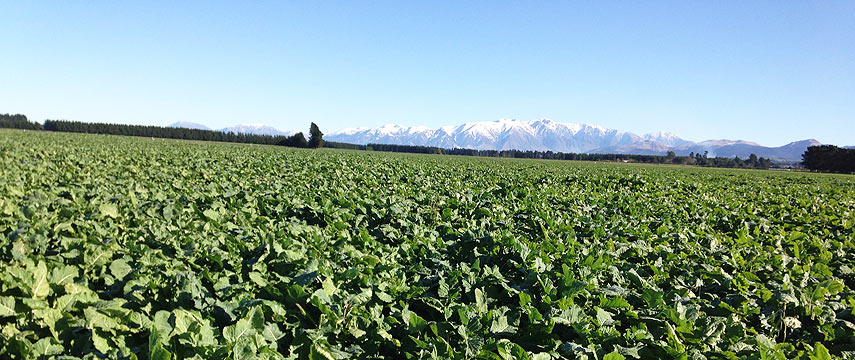
What sort of brassica are you after?
- Cleancrop brassica– The HT Brassica system has a range of cultivars that have been BRED to be tolerant to the sulphonyl urea herbicide Telar, a broad-spectrum herbicide that provides excellent control of broad leaf weeds from the pre-emerge.
- Kale– Kale (also known as Chou Moellier) is winter active and mainly used as a “winter feed”.
- Rape– Forage rape may be sown alone or in mixtures as a specialist “summer to winter feed”.
- Forage brassica– Forage brassica (also known as Leafy Turnip) may be sown alone or in mixtures as a specialist “summer to winter feed”.
- Turnips– Turnips can either be spring (for summer feed), summer or autumn (for autumn or winter feed) sown.
- Swedes– Swedes are sown between November to early December, either ridged in cool areas, or conventionally drilled to provide specialist winter feed.
- Fodder Beet– Fodder Beet is one of the highest yielding forage options available to farmers, but it is actually not a brassica!
Cleancrop brassica:
The Cleancrop™ Brassica System is a simple weed management system which eradicates a range of key problem weeds, commonly found in brassica crops throughout New Zealand. These weeds compete with your brassica crop decreasing yield production. It’s time to take back control of your crop this spring.
KEY BENEFITS OF THE CLEANCROP BRASSICA SYSTEM ARE A SIMPLIFIED WEED CONTROL.
The Cleancrop Brassica System is an integrated weed management programme that offers excellent control of key problem weeds in brassica.
BRASSICA CULTIVARS WITH EXCELLENT AGRONOMIC PERFORMANCE
Cleancrop brassica cultivars containing the CleancropTM Brassica System technology have been bred from the very successful Plant and Food Research Ltd/PGG Wrightson Seeds joint breeding programme.
Forage Innovations Ltd. in addition to their tolerance to Telar herbicide, each cultivar, depending on species has improved forage yield, palatability, disease, and insect tolerance.
BEST PRACTICE GUIDE AND STEWARDSHIP PLAN
The CleancropTM Brassica System must be implemented on-farm in accordance with best Practice Guide and stewardship plan. Developed by PGG Wrightson Seeds and DuPont, this programme is designed to optimise the on-farm performance of the CleancropTM Brassica System.
NOTE: THE CLEANCROPTM BRASSICA SYSTEM OF CLEANCROP BRASSICA SEED PLUS TELAR HERBICIDE SHOULD NOT BE USED IN THE CROP ROTATION IN THE YEAR PRIOR TO PLANTING FODDER BEET OR POTATOES DUE TO SENSITIVITY OF THESE CROPS TO TELAR.
WHERE TO USE?
The Cleancrop™ Brassica System can be used where a simple weed control programme is required that controls
a wide range of historically difficult-to-control weeds in brassica crops.
TARGETED WEED SPECIES
| Calandrinia | Scentless Chamomile | Wild Turnip* |
| Scotch Thistle | Chickweed | Rayless Chamomile |
| Shepherds’ Purse | Cornbind | Willow Weed |
| Spurrey (Yarr) | Docks | Redroot |
| Dandelions | Twin Cress | Yellow Gromwell |
| Stinking Mayweed | Fathen | Scarlet Pimpernel |
| Hawksbeard | Vetch | Californian Thistle* |
| White Clover | Nodding Thistle |
* Apply Telar® post emergence when the Cleancrop brassica crop is at the fourth true leaf growth stage
GRAZING RECOMMENDATIONS
The grazing withholding period is 28 days after Telar® application for Cleancrop rape and Cleancrop leafy turnip, and 42 days after Telar® application for Cleancrop bulb turnip and Cleancrop swede.
Cultivars Available:
| Cultivar | Days to grazing | Hectare pack size and Sowing rate | Product information |
| Cleancrop Firefly Kale | 150 – 220 | Available in 1 and 5 ha packs
Sow @ 4 kgs /hectare |
Intermediate kale type
For more information please click here: https://pggwrightsonseeds.com/brassicas/cleancrop/firefly-kale
|
| Cleancrop Sarge Kale | 150 – 220 | Available in 1 and 5 ha packs
Sow @ 4 kgs /hectare |
Sarge is a short to medium type kale, which offers an alternative to Kestrel kale when a high degree of weed control is required via the Cleancrop™ system. Sarge has a high leaf to stem ratio and is soft stemmed which leads to improved crop utilisation.
Due to its stem softness and later flowering, Sarge can be sown to supplement diets of grazing animals not only in winter but can be utilised as an alternative late autumn forage and if lightly grazed can regrow for winter feed. For more information please click here: https://pggwrightsonseeds.com/brassicas/cleancrop/sarge-kale
|
| Clean crop
Aspiring swedes |
150-230 | Available in 1, 5 and 10 ha packs.
Sow @ 1 kg/hectare Also available pelleted in 1 ha and 6 ha pails. Sow at 90 k seeds per hectare |
Cleancrop™ Aspiring swede is a soft, early-maturing, yellow-fleshed swede, offering a Cleancrop™ swede option for those farmers who prefer the bulb softness, traditionally seen in Major Plus, and more recently in Earnslaw swede. Relative to Major Plus, Cleancrop™ Aspiring swede offers improved dry-rot and Alternaria tolerance, with the ability to control weeds through adoption of the Cleancrop™ Brassica System. The combination of soft bulb and greater disease tolerance makes Cleancrop™ Aspiring an option for all stock classes, including younger stock when swedes are being used.
For more information please click here: |
| Cleancrop
Hawkstone Swede |
170 – 250 | Available in 1, 5 and 10 ha packs.
Sow @ 1 kg/hectare Also available pelleted in 1 ha and 6 ha pails. Sow at 90 k seeds per hectare |
High yielding yellow fleshed swede with medium maturity. Excellent disease resistance. Available in pellet form as well.
For more information please click here https://pggwrightsonseeds.com/brassicas/cleancrop/hawkestone-swede |
| Cleancrop Rape | 90 – 110 | Available in 1 and 5 ha packs
Sow @4 kgs/hectare |
High yielding multi graze forage rape with very good leaf percentage and crop utilization.
For more information please click here: https://pggwrightsonseeds.com/brassicas/cleancrop/rape
|
| Cleancrop Bulb Turnip Winter or Summer | 80 – 110 | Summer crop @ 2kg/ha.
Available in 1, 5 and 10 ha packs. Also available in 1 ha pelleted pails. Each pellet contains 90K seeds Winter crop @ 1kg/ha Available in 1, 5 and 10 ha packs. |
Suitable for summer/autumn/winter feed.
For more information please click here https://pggwrightsonseeds.com/brassicas/cleancrop/bulb-turnip |
| Cleancrop
Toto Turnip |
55-90 |
Sow @ 2 kgs/hectare Available in 1 and 5 ha packs Also available in 1 ha pelleted pails. Each pellet contains 90K seeds
|
Early maturing summer turnip with a high yield potential.
Tankard bulb shape with excellent crop utilisation (90%) Improved turnip mosaic virus tolerance Pair alongside the later maturing Cleancrop™ bulb turnip, for 60 days of feed For more information please click here: https://pggwrightsonseeds.com/brassicas/cleancrop/toto-turnip |
| Cleancrop Leafy Turnip | 42 – 70 | Available in 1 and 5 ha packs
Sow @4 kgs/hectare |
A multi-graze Pasja type with reduced bolting and is suitable for all stock types. For more information please click here:https://pggwrightsonseeds.com/brassicas/cleancrop/leafy-turnip |
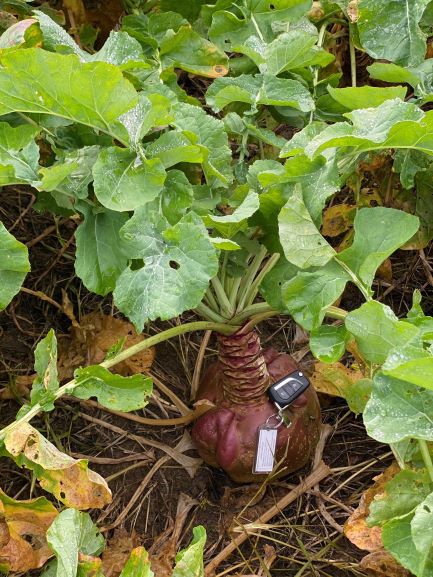
Clean Crop Hawkstone swedes measured at 25 tonnes DM/Hectare (15% DM)
Great results for our client proving that, clean crop Hawkstone swedes offer improved plant genetics and freedom from weeds ensuring high yields are possible.
Contact Link: If you have any other questions on Clean Crop brassica please contact Specialty Seeds.
PALLATON RAPHNO®
Developed by PGG Wrightson Seeds under the Forage Innovations joint venture with Plant and Food Research. Pallaton Raphno is a raphanobrassica, a hybrid between Brassica oleracea (kale) and Raphanus sativus (radish).
Full commercial release of Pallaton Raphno is Spring 2018.
FARM TYPE
The goal of the breeding programme was to combine six stacked traits, which would perform for New Zealand farmers within increasingly challenging environments.
The six traits include:
- High Forage Yields, from multiple grazing’s
- Plant Persistence, under multiple grazing’s
- Drought Tolerance
- Clubroot Tolerance
- Aphid Tolerance
- Grazing Flexibility
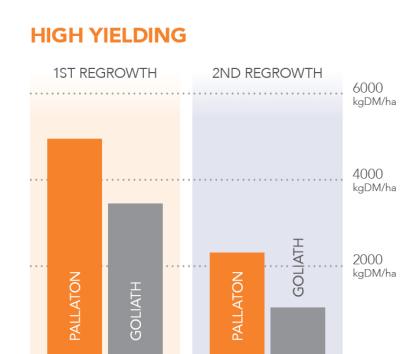
HIGH YIELDING
14% increased yield advantage relative to Goliath forage rape in a multi-graze system (total cumulative yield from repeat harvest).
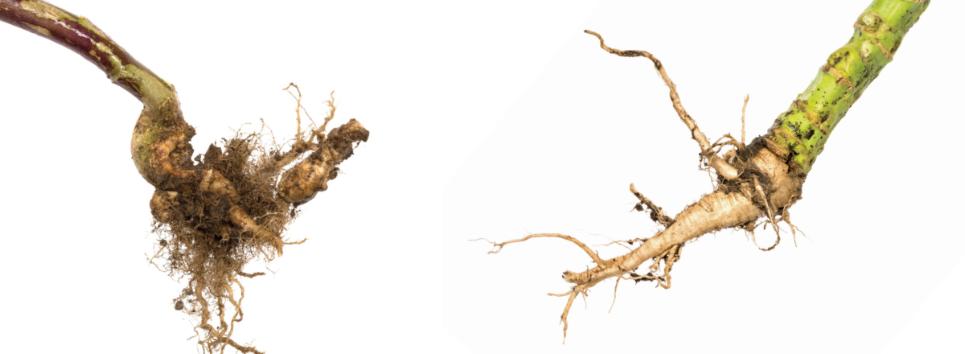
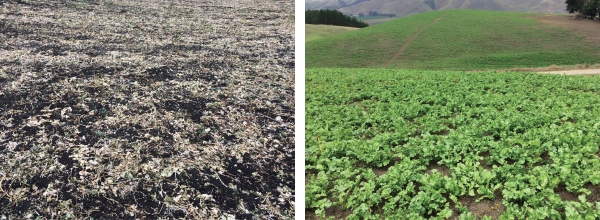
CLUBROOT TOLERANCE
Forage rape (left) and Pallaton (right) under clubroot pressure.
Pallaton Raphno® has a high tolerance to clubroot. In vitro innoculation pot trials and field trials to date have shown strong tolerance to Pukekohe, Hawke’s Bay and Southland strains of clubroot.
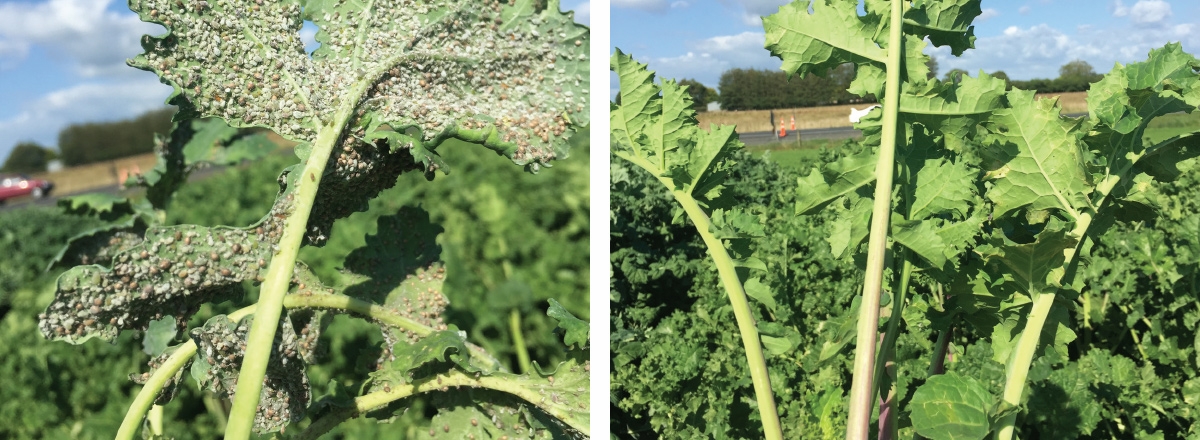
APHID TOLERANCE
Forage rape (left) and Pallaton (right) under aphid pressure. Both plants have had identical treatment and are in side-by-side plots.
Pallaton has a 14% increased yield advantage to Goliath forage rape in a multi-graze system (total cumulative yield from repeat harvests).
PERSISTENCE UNDER MULTIPLE GRAZINGS
Pallaton has excellent re-growth potential and has the ability to persist for 4-5 grazings over a 12 month period.
FLEXIBILITY
Graze Pallaton as early as 50 days after sowing (DAS), to maximise crop utilisation and regrowth potential. It can be deferred up to 120 DAS, however utilisation and regrowth potential will be reduced. Pallaton does not have a specific maturity requirement.

DROUGHT TOLERANCE
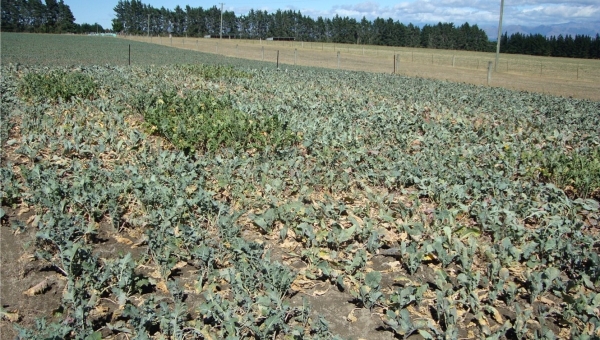
38% increase in water use efficiency (WUE) relative to Goliath forage rape.
For more information on this product please click here:
https://pggwrightsonseeds.com/brassicas/pallaton-raphno
Kale:
(Sowing rates: 4 – 5 kgs per hectare)
Kale can provide high dry matter/ hectare yields however for best results kale requires high soil fertility and good soil moisture. Kale is suitable for cattle, sheep, and deer but the taller or giant types are best used for only cattle grazing, while the shorter, leafier cultivars are more suited to sheep and deer. Higher sowing rates lead to thinner and more palatable stems.
There are three types of Kale:
- Medium Stem types: Lowest growing of the three Kale types medium stem kales normally have high leaf to stem ratios which makes utilization better but have the lowest yield potential of the three types. Also, medium stem types have improved lodging resistance which make them excellent in snow prone areas. Suitable for all stock types but normally used for sheep grazing
- Intermediate Stem types: These types are the result of crossing a medium stem and giant stem type together to get the most desirable traits from each parent. Higher and narrower stems intermediate kales have very good leaf to stem ratios leading to higher palatability and utilization. Suitable for all stock types
- Giant Stem types: Giant stem types obtain more of their yield from their stems rather than from their leafs. In the man these kales are only used for cattle/dairy cow grazing where a high overall yield per hectare is required. Grazing management is very important otherwise they can have poorer quality than the other two types.
Cultivars
| Height | Cultivar | Product information |
| Bombardier EG | Medium | Bombardier EG kale means you can look after your animals, with more energy per bite and less wastage, which is better for both animals and the environment.
For more information, please download the Barenbrug Bombardier information. https://www.barenbrug.co.nz/dairy/cultivars/brassica/kale
|
| Coleor | Small-Medium | Coleor is a high yielding, leafy, diploid Kale of short to medium height, very high leaf to stem ratio and very good winter hardiness.
For more information please download the
|
| Corsa | Giant | Corsa is a new generation giant type kale that has been bred to revolutionise the giant kale market. With higher leaf percentage and enhanced stem quality than conventional giant kales. Corsa will deliver a high-volume, high-quality feed for your animals.
For more information, please download the Corsa information. https://pggwrightsonseeds.com/brassicas/kale/corsa
|
| Gruner | Giant | Gruner is a very high yielding giant type kale with potential yield of 17,000kg DM/ha.
For more information please download the |
| Kea | Intermediate | Bred in New Zealand, Kea is an intermediate kale selected for its high dry matter yield and leaf percentage. Thanks to its rapid growth and high leaf content, Kea offers flexibility: it can be used as a high-yielding single-graze Winter feed or as a multi – grazed option. When planted in early Spring, Kea can be grazed multiple times throughout the Summer and Autumn months. This adaptability adds flexibility to farm systems and transforms how kales have been historically utilised on New Zealand farms. Kea was bred to combine the winter yield characteristics of intermediate and giant type kales with increased leafiness, enhancing quality, utilisation, and animal performance.
For more information, please download the |
| Kestral | Medium | Kestrel is a medium height cultivar with digestible thick stems, high leaf to stem ratio and low SMCO levels.
For more information please download the |
| Proteor | Intermediate | Proteor is a winter hardy, intermediate stem kale with a high yield potential and high leaf-to-stem ratio, typically +/- 50%. The high leaf to stem ratio enables it to provide the best quality feed. Couple this with its high yield potential and you have a highly desirable Kale to maximise winter production on farm.For more information, please download thehttps://www.cropmarkseeds.com/forage-seeds/proteor/ |
| Regal | Intermediate | An intermediate height, low yielding cultivar bred for a high leaf percentage. Has a high total yield and winter hardiness.
For more information please download the |
| SovGold
|
Intermediate | SovGold is a modern New Zealand bred kale that combines excellent quality with a high yield potential. SovGold has a very high-top end yield potential, although average yields are around 10-14 t DM/ha, depending on management and environment. SovGold will be well suited to all cattle grazing systems and sheep systems that sow late to control crop height for utilisation by sheep.
For more information, please download the Sov Gold information. |
Rape:
(Sowing rates: 0.5 – 1 kgs per hectare)
Rape can be sown from early spring to late summer and is generally ready to graze 12-16 weeks after sowing. Rape can be sown on lower soil fertility soil than most other brassicas. With good soil fertility and moisture, yields of 8 tonne DM/ha can be achieved. (Note: Some care is required when grazing rape and it is best to allow the crop to fully mature before grazing and to gradually increase Rape in their diet.)
| Cultivar | Regrowth | Days to Maturity | Product information |
| Goliath | Good | 90 – 110 | A new generation rape x kale interspecies cross. Bred and trialled by Plant & Food Research (NZ) for New Zealand grazing systems. Highest yielding multi graze giant rape available, a potential yield of 10,500kg DM/ha. Multi-purpose forage rape with excellent summer/ autumn/early winter feed. Superior regrowth potential with excellent winter keeping properties. Good aphid tolerance.
For more information, please download the |
| Greenland 11 | Good | 70 – 84 | Very late flowering, leafy type. Medium plant height. Good palatability with aphid tolerance. Multi-graze flexibility. Summer/autumn/winter feed option.
For more information, please download the |
| Interval | Good | 90 – 110 | Interval is a tall, fast establishing rape ideal for summer, autumn and winter feed. It is tough, dependable, and has been proven to yield very well across a wide range of conditions. Interval can be sown from spring through to early autumn to provide a bulk of high-quality feed typically in 90-110 days. Spring sowings can be grazed in summer/early autumn then left to regrow for winter feed.
For more information, please download |
| Mainstar | Good | 70-84 | Mainstar is a modern early maturity rape. Traditionally rape has been used as a summer lamb-finishing crop and ewe-flushing feed. Mainstar has excellent regrowth potential and good frost tolerance extending grazing times from early summer to late winter.
Mainstar has extremely good aphid tolerance. While it’s use won’t completely remove the need to spray for aphids, it will greatly reduce the need within many crops. For more information, please download the https://www.agricom.co.nz/products/brassicas-and-beets/forage-rape/mainstar
|
| Pillar | Good | 90 -110 | Leafy, giant-type, very fast establishing, good disease resistance. Can be sown in spring or autumn and is suitable for sheep, cattle and deer
For more information, please download the |
| Spitfire | Good | 90 – 100 | Spitfire is a multi-purpose rape that can be sown in spring for lamb or cattle finishing or summer dairy grazing or sown in mid-summer to early-autumn for autumn and winter grazing.
For more information, please download the |
| Titan | Good | 70 – 90 | A new generation rape x kale interspecies cross. Bred and trialled by Plant & Food Research (NZ) for New Zealand grazing systems. Highest yielding multi-graze, intermediate height rape available with a potential yield of 10,000kg DM/ha. Highest animal preference cultivar available. Excellent aphid and virus tolerance.
For more information, please download the |
Forage brassica:
(Sowing rates: Alone: 3 -4 kg. Mix: 0.5 – 1kg per ha)
Forage brassicas can be sown from early spring to late summer and have minimal maturity requirements before grazing. Forage brassica can be sown on lower soil fertility soils than most other brassicas. With good soil fertility and moisture, yields of 10-12 tonne DM/ha can be achieved. (Note: Some care is required when grazing stock on Forage brassica and it is best to gradually increase it into their diet.)
| Cultivar | Days to first grazing | Product information |
| Hunter | 42 – 56 | Hunter is a quick-growing, leafy turnip, with minimal bulb development and is best suited to multiple grazings.
For more information, please click here: |
| Pasja II | 42 – 70 | High yields from successive grazings (potential yield of 12,000kg DM/ha over multiple grazings). Fast establishing, high quality feed ready for grazing within 42-70 days of sowing. Excellent plant persistence after multiple grazings. Provides a flexible grazing option for all stock classes over summer and autumn. Minimal ripening requirement.
For more information, please click here: |
| RGT Pacer | 45 – 50 | RGT Pacer is suited to medium-high fertility soils with summer moisture or irrigation, providing multiple grazings to meet summer and early autumn feed requirements.
For more information, please click here: |
Turnips:
(Sowing rates: 0.5 – 2kg per ha)
Turnips vary in yield potential, ploidy level, maturity, size of bulb, bulb keeping quality, and these factors considerably influence the choice and intended mixtures with rape or grasses, particularly Italian Ryegrasses. Yields tend to increase with later maturity types and vary from 5 to 8 tonne DM/ha. Turnips being Root Crops provide greater resistance to aphid than rape crops but are more senstitive to deficiencies of boron, particularly in wetter areas. Stock grazing root crops need sound teeth to make effective use of them, and energy requirements are higher because of high water content of the bulbs.
Summer Turnips:
| Cultivar | Ploidy type | Days to Maturity | Product information |
| Appin | Diploid | 42-60 | Appin leafy turnip has a very high initial growth rate up until first grazing. Tops can be grazed initially, then regrowth of leaf and bulb will occur after a short spell.
For more information, please contact us
|
| Barkant | Diploid | 60-90 | Highest yielding summer bulb turnip available, a potential yield 15,000kg DM/ha. High leaf to bulb ratio resulting in high levels of protein. Early maturing for excellent summer feed.
For more information, please download the |
| Dynamo | Diploid | 60-90 | Dynamo turnip is a high yielding summer crop for dairy cows. It provides large volumes of low-cost quality feed with a high proportion of bulb, and good bulb keeping ability.
In trials Dynamo has shown high yield, not significantly different from the other top cultivars. Replacing a poor performing pasture with a crop of Dynamo makes financial sense. For more information, please download the https://www.barenbrug.co.nz/crops/products/dynamo
|
| Marco | Diploid | 55-65 | Marco tetraploid turnip is the fastest establishing turnip, meaning less days out of pasture. High quality tetraploid turnip for greater animal performance benefits.
For more information, please download the |
| Rival | Tetraploid | 84-98 | Rival summer turnip is an early-maturing tankard-shaped bulb turnip bred for high leaf production. Rival is ideally used as part of a pasture renovation program on dairy farms that have a period of dry and/or a loss of pasture quality through January and February.
For more information, please download the |
Winter Turnip varieties:
| Cultivar | Days to Maturity | Product information |
| Green Globe | 90 – 120 | Multi-purpose product can be sown for grazing in summer, autumn and winter. Most winter hardy bulb turnip available. Good yield potential (10,000kg DM/ha).
For more information, please download the |
| New York | 110 | New York turnip is a medium-maturity winter turnip, bred as a York globe replacement. It is a white-fleshed, purple-skinned, oval-bulbed, diploid turnip. For more information, please download the |
| York Globe | 110 | Contact Specialty Seeds for more details |
Swedes:
Some varieties are also available in 90 k pelleted seeds pails, enough for 1 hectare.
Swedes can yield between 10 to 16 tonne DM/ha over the winter months. Swedes being Root Crops provide greater resistance to aphid than rape crops but are more sensitive to deficiencies of boron, particularly in wetter areas. Generally yellow fleshed swede varieties are commonly used for human consumption because of improved flavour and lower water content compared to white fleshed type. Stock grazing root crops need sound teeth to make effective use of them, and energy requirements are higher because of high water content of the bulbs.
| Cultivar | Bulb Colour | Days to Maturity | Product information |
| Clutha gold | Yellow Fleshed | 170-220 | Clutha Gold is the latest swede bred from the Forage Innovations plant breeding joint venture between Plant and Food Research and PGG Wrightson Seeds and has been developed to supersede Aparima Gold swede. Clutha Gold has a significant yield advantage over Aparima Gold while maintaining its disease tolerance to clubroot and dry rot. Clutha Gold also has an additional disease tolerance to the leaf disease, powdery mildew. It can be used for all farm types and is suitable for sheep, cattle and deer grazing.
For more information, please click here: |
| Earnslaw | Yellow Fleshed | 150 to 220 | Earnslaw is a traditional, yellow-fleshed swede superseding the current softest swede in the market, Major Plus. Earnslaw retains the same renown characteristics of Major Plus including early maturity and a soft bulb but has the additional benefit of improved dry-rot and Alternaria tolerance resulting in higher yields and better winter keeping abilities. The combination of soft bulb and greater disease tolerance makes Earnslaw swede an ideal swede option for all stock classes including younger growing animals.
For more information, please click here: |
| Major Plus | Yellow Fleshed | 150 – 230 | A main crop, early maturing, soft bulbed swede. Bred and trialed by Plant & Food Research for New Zealand grazing systems. Good yielding swede with a potential of 16,000 kg DM/ha. Yellow-fleshed, light purple skinned bulb.
For more information, please click here: |
| Massie | Yellow Fleshed | 150-230 | Massie is a low drymatter swede with an early maturity date like Domain. Yellow fleshed Massie is suitable for all stock classes and was selected to have improved club rot tolerance. Massie is better as a first-year swede and is not recommended as a second crop swede or to be sown after other brassica crops.
Massie has early maturity and is ideally suited to early winter grazing complementing the later maturing, Triumph. For more information, please click here: https://www.agricom.co.nz/products/brassicas-and-beets/swede/massie |
| Saddleback | Yellow fleshed | 150-230 | Saddleback is a new swede variety selected for its robust reliable and consistent
yields. Selected from a breeding program over a decade in the making; Saddleback performs under pressure from a range of diseases which include club root, dry rot, BWYV and powdery mildew. Other desirable traits of Saddleback swedes include consistent shaped bulbs with strong leaf retention and trials prove it’s reliable and consistent yields. For more information, please click here: |
| Triumph | Yellow Fleshed | 170-210 | Triumph is a very high yielding yellow fleshed swede with good dry rot and mildew tolerance. This new generation swede has a uniform bronze/purple skinned bulb and very good leaf holding characteristics.
For more information, please click here: https://www.agricom.co.nz/products/brassicas-and-beets/swede/triumph |
Other links:
Download Link: Download the Specialty Seeds Brassica growing guide brochure.
Download Link: Download the Specialty Seeds “How to measure a Brassica crop.”
https://specseed.co.nz/downloads/HowtomeasureaBrassicaCrop-SpecialtySeedsNZ.pdf
Download Link: Download the Specialty Seeds “Safety tips for feeding brassica.”
https://www.specseed.co.nz/downloads/SafetytipsforfeedingBrassica-SpecialtySeedsNZ.pdf